
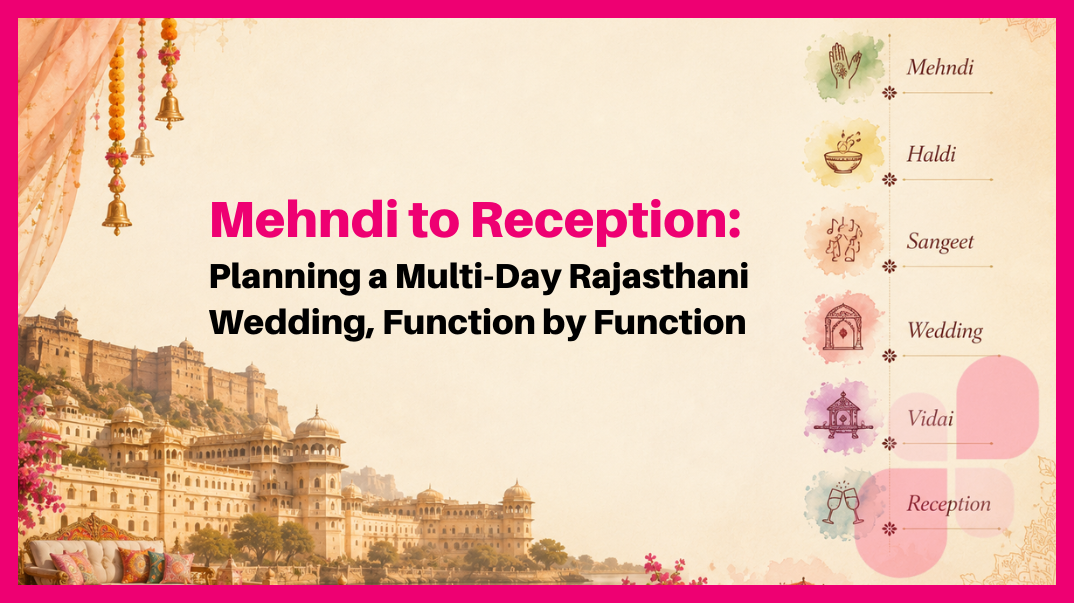
If you’ve ever tried explaining an Indian wedding timeline to someone unfamiliar with it, you know the confused look that follows: “Wait, how many separate events are there?” A Rajasthani wedding, done properly, isn’t one day; it’s a string of functions, each with its own mood, its own outfit, its own vendor needs, and its own budget line. Trying to plan all of them at once, with one undifferentiated to-do list, is how couples end up exhausted and over budget by the third function. Planning them individually, function by function, is far more manageable. Here’s how to think about each one.
Mehndi: relaxed, colorful, and easy to get wrong by overspending
The mehndi function should be the easiest, most low-pressure event on your calendar, but it’s also where couples sometimes overspend without meaning to on ornate stage decor for an event that’s fundamentally about sitting around and getting henna applied. Keep the vendor list simple: one or two skilled mehndi artists (book them early; the good ones fill up fast during wedding season), simple marigold-and-drape decor, and a casual catering setup like chaat counters or a live snack station rather than a full sit-down meal. This is also the function where a good in-house or hired dhol player and a relaxed playlist do more for the atmosphere than expensive lighting ever will.
Budget-wise, this should be one of your lighter functions. If your mehndi decor quote is approaching your sangeet or wedding-day numbers, something’s off.
Haldi: small, sunny, and best kept intimate
Haldi is traditionally a family-only affair, and it works best when you resist the urge to turn it into a full production. Yellow marigolds, simple seating, and good natural light for photos are really all you need. If you’re hiring a photographer for the full wedding package, confirm whether haldi is included or billed as a separate half-day, since some photographers treat it as an add-on.
Sangeet: where the real production budget goes
If there’s one function worth investing serious planning energy into, it’s the sangeet. This is the event where choreography, sound systems, stage lighting, and often a dedicated anchor or emcee come together, and where the difference between an average and an excellent vendor is most visible to your guests. Book your choreographer well in advance; a good one will want weeks, not days, to prepare family performances properly. Coordinate directly with your DJ or sound team on the music list ahead of time rather than leaving it to the night, and if you’re bringing in an anchor, give them a clear rundown of the evening so transitions between family performances don’t drag.
This is also the function where a solid sound and lighting setup matters more than elaborate decor. Guests remember an energetic, well-run sangeet far more than they remember the centerpiece arrangements.
The wedding ceremony: tradition first, logistics second
The main ceremony is where Rajasthani customs are most visible: the baraat, the phera rituals, the specific rites your family follows. This is also usually the function with the most moving parts: priest coordination, baraat transport and band, mandap decor, and the largest catering headcount of the whole event. Confirm your priest’s timing requirements early since auspicious muhurat timings can shift your entire day’s schedule, and make sure your decorator, caterer, and venue team are all working off the same final timeline, not three slightly different versions.
Reception: the function that photographs the most, so plan lighting accordingly.
By the time reception rolls around, most couples are running on fumes, which is exactly why it pays to have this function’s logistics locked down well in advance rather than figured out on the day. Reception decor tends to be the most elaborate and expensive of all the functions, largely because it’s also the most photographed. Talk to your decorator specifically about lighting for photography, not just ambient lighting; the two aren’t the same thing, and a venue that looks beautiful to the eye can photograph poorly under the wrong light temperature.
A practical way to keep it all organized
The reason multi-day weddings feel overwhelming isn’t the number of functions; it’s trying to track vendors, timelines, and guest lists for all of them in your head or across scattered WhatsApp chats. This is exactly the kind of chaos Wedroz’s planning tools are built to cut down on: a shared guest list and RSVP tracker so you’re not maintaining five different spreadsheets for five different functions, and a wedding checklist that breaks tasks down by event rather than lumping everything into one intimidating list.
And when it comes to actually booking vendors for each function- the mehndi artist, the sangeet choreographer, the wedding-day decorator, the reception caterer, you don’t need five different search processes either. Browsing verified vendors by category on Wedroz means you can shortlist a mehndi artist and a full wedding decorator in the same session, compare starting prices, and reach out directly without a commission inflating either side’s number.
Treat each function as its own mini-event with its own budget, its own vendor shortlist, and its own timeline, and the whole multi-day wedding stops feeling like one giant, unmanageable project. It becomes what it’s actually meant to be: five or six genuinely joyful celebrations, each one distinct, each one memorable in its own way.